


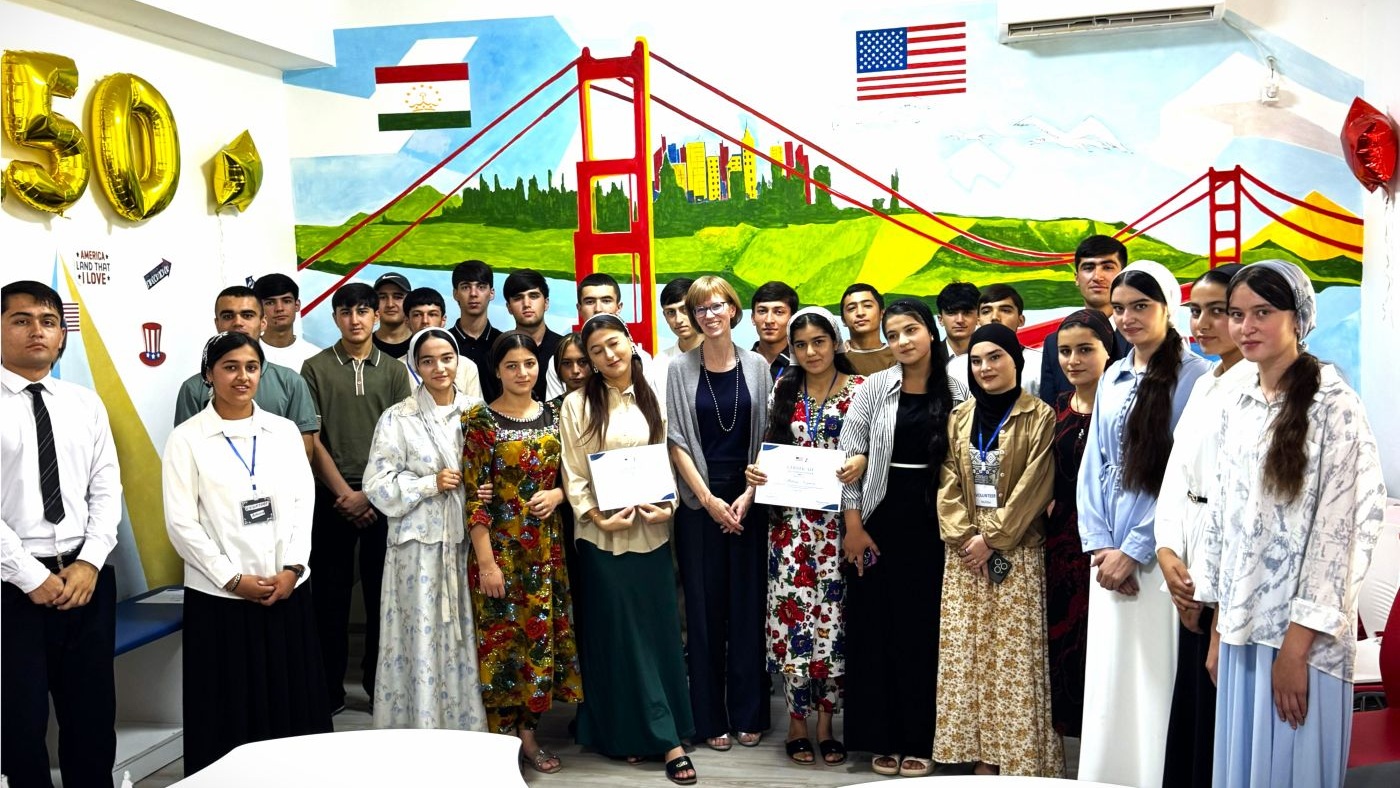
Two hundred and fifty years ago, the Founding Fathers of the United States of America understood that free minds equipped with knowledge and education drive innovation, enterprise, and growth. That same principle still guides the United States today, both at home and abroad. Our approach to education cooperation across the world is clear: education and skills-building are not charity – they are investments that pay dividends for mutual security and prosperity. America’s investments in Tajikistan over the last 35 years have made both our countries stronger.
By: Carson Relitz Rocker, Chargé d’Affaires, a.i., U.S. Embassy in Dushanbe
I have recently written about the security and health cooperation that protects both Tajikistan and the United States. Today, I want to focus on how our two countries have learned from each other – and how this ongoing exchange serves our mutual interests.
Communication Underpins Cooperation
For 35 years, communication has been the foundation of this partnership — and the numbers show it: hundreds of thousands of textbooks delivered; tens of thousands of teachers trained; and a generation of Tajik leaders now fluent in the language of global business and diplomacy.
For example, since 2004, the U.S. Embassy’s English Access Scholarship Program has provided 2,500 talented Tajik youth two-year courses of after-school English instruction. Since 2009, more than 40 English Language Fellows have taught at Tajik universities. Our English Without Borders network of English teachers has grown to 4,000 members who benefit from resources and training.
We have continued to back this investment in communication: in 2024, the U.S. Embassy delivered 242,000 English textbooks for grades 10 and 11, reaching every school in Tajikistan. We’ve trained roughly 4,000 of Tajikistan’s secondary English teachers. Through Fulbright, the U.S. government’s premier academic exchange program, nearly 100 early-career teachers have studied in American classrooms, and more than 100 teachers have completed our courses on teaching English as a second language.
Over the past decade, the U.S. government invested heavily in education programs in Tajikistan, resulting in significant improvement in early-grade reading outcomes across the country. For example, Grade-2 reading comprehension rates climbed from just 13 percent of learners meeting standards to 51 percent. That is sustained improvement in foundational reading outcomes for hundreds of thousands of Tajik primary-school students – wins that will lead to greater workforce participation and economic growth, creating exactly the kind of skilled, English-speaking workforce that gives American businesses a natural partner in Central Asia.
Moreover, tens of thousands of educators received U.S.-led teacher development training. Early efforts trained several thousand educators annually, growing to a peak year in which more than 20,000 teachers and nearly 300 school directors completed training – reaching schools across the country. This investment extended beyond classroom instructors to include support for parent-teacher associations and education administrators, reflecting a holistic approach to strengthening the human capital behind Tajikistan’s education system.
Since 2019, our English for Government Officials program has trained more than 550 officials across ministries handling trade, mining, security, and energy – those overseeing the industries crucial to Tajikistan’s economy – supporting President Rahmon’s mandate that government workers learn foreign languages. Our English for Journalists program has given more than 700 Tajik journalists and editors direct access to primary-source reporting, helping them better inform the public. More of Tajikistan’s rising leaders are choosing English as their foreign language, a shift that gives them better access to cutting-edge American technology, the vibrant American private sector, and eager American business partners.
This cross-cultural communication exchange works in both directions. Each year, more than 100 Tajik citizens travel to the United States through a range of U.S. academic, professional, and leadership exchange programs — including FLEX, IVLP, Open World, Global UGRAD, SUSI, TechGirls, and TechWomen — while over 50 Americans study Persian languages in Tajikistan annually. This means that while young Tajiks are learning English, young Americans are learning Tajiki, to the benefit of both our peoples.
Cooperation Delivers Results
Today, nearly 9,000 Tajik alumni of U.S. exchange programs live and work across every region of this country. Twenty-three have served as Ministers or Deputy Ministers since 1993. Nearly a hundred more serve in the judiciary, prosecutor’s office, tax administration, and local government.
This network of alumni is delivering for the people of Tajikistan by leveraging U.S. expertise and diversifying Tajikistan’s trading partners. For example, in the field of critical minerals, International Visitor Leadership Program alumni geology and mining oversight agencies, and a Fulbright scholar researches strategic minerals at the Technological University of Tajikistan. These minerals are vital to semiconductor and battery production, so reducing dependence on chokepoints in global supply chains is a key opportunity to build cooperation between the United States and Tajikistan. Because U.S. exchange programs open doors and equip participants to lead, alumni now form the cornerstone of Tajikistan’s private sector—including key leadership at FIFTYFIVE GROUP, Alif Bank, SmartHub, and the American School—each laying the groundwork for deeper American investment and trade, benefiting both our countries.
Through our alumni network, we continue supporting entrepreneurship, digital governance, and youth engagement against extremism. Sixty-four young women completed the iCODE project in app development, and 40 more built tech skills at Tech4Change Camps. These are practical skills that create real economic opportunities, provide stability, and contribute to a tech-savvy workforce that attracts international investment to Tajikistan.
Our cooperation extends to the cultural sphere as well. Twenty-five years of projects through the Ambassadors Fund for Cultural Preservation helped the ancient city of Panjakent earn UNESCO World Heritage status. In 2023, American DJ Carl Hollier brought hip-hop culture to thousands of Tajiks at the Roof of the World Festival, and The Pipeline Vocal Project toured the country and performed beloved Tajik song “Chaki Chaki Boron” to warm reviews nationwideThis is the type of face-to-face diplomacy that opens doors for enduring American-Tajik relationships. These investments, along with the commitments to which both our countries agreed in our November 2025 C5+1 Joint Statement on Cultural Heritage, deepen our partnership in preserving cultural heritage, disrupting illicit trade in cultural property, and enhancing cultural collaboration.
Results Build Stronger Relationships
Thirty-five years is long enough to watch a textbook program grow into 242,000 books in classrooms nationwide, and a scholarship recipient become a Deputy Prime Minister. This did not happen by accident. This is a tangible legacy of our partnership. It reflects the relationships developed over Tajikistan’s 35 years of independence, relationships that drive our shared security and prosperity.
As we mark 250 years of American independence and 35 years of U.S. partnership with Tajikistan, the results speak for themselves: a rising generation with confident language abilities, cutting-edge tech skills, and a commitment to growing economic, security, and cultural ties between the United States and Tajikistan. That’s the America First approach, delivering English, technology skills, and exchange of ideas and best practices, one community at a time.
Join us on Telegram! Be aware of all news! https://t.me/sugdnewss. As well you can receive information on Facebook, Instagram and OK


